Podcast: Play in new window
Subscribe: Apple Podcasts | Spotify | RSS
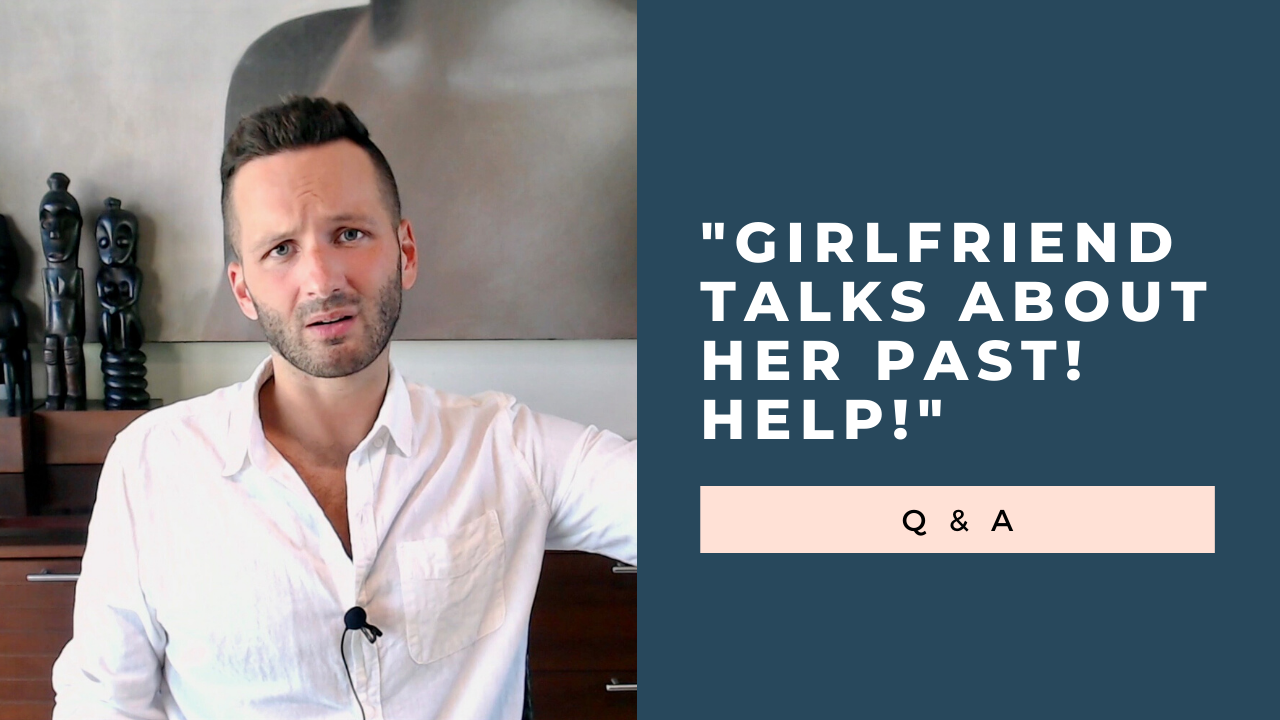
“What should I do when my girlfriend talks about her past?”
Many male readers write to me asking what they should do when their girlfriend talks about her past. If that sounds familiar, I would start with a calm, private conversation about the specific details you would rather not hear. You can ask for consideration without asking her to pretend she never had a life before you.
The distinction matters. An occasional mention of an ex, graphic sexual stories in front of friends, and deliberate comparisons with a previous partner call for different responses. Let’s look at a reader’s question about where to draw that line.
Today’s email comes from Dylan, who writes:
My girlfriend talks about her past… The thing that gets my jealousy going the most is when my girlfriend casually mentions having had sex with someone else or a sexual thing that once happened to her, generally in a group setting when that sort of topic is brought up. This is confusing for me because I don’t want to control what she can and can’t say and honestly if it wasn’t for this, I’d find the anecdotes funny too. But it just makes me feel so awful when it comes up and I just don’t want to hear about it.
Where is the line between exhibiting damaging controlling behavior and putting reasonable steps in place to avoid these feelings?

Zachary Stockill: Thanks for your message, Dylan. And there’s a lot going on in this email, but I’m going to try to address each point you raise one by one.
First, Dylan, I want to pick up on the last question in your email: where is the line between controlling your girlfriend and setting a reasonable limit?
Take responsibility for your response without dismissing your feelings
You may not choose the first flash of jealousy when you hear something you would rather not know. Your girlfriend’s words can affect you. What you can work on is how you respond: whether you ask another painful question, make an accusation, or give yourself a moment before speaking.
I think it helps to separate what happened from the meaning you attach to it. “She mentioned an old experience” is one thing. “She must prefer him to me” is a conclusion. The first does not establish the second.
Taking responsibility for your response also leaves room to ask your girlfriend to treat you with consideration. You can do both.
Secondly, I completely understand why this would bug you.
I think it would bug a lot of guys.
You’re in a social setting and your girlfriend mentions having sex with someone else. I can understand why that would be uncomfortable. Even someone who does not struggle with retroactive jealousy may prefer not to hear graphic details about their partner’s sex life.

What to say when your girlfriend talks about her past
I would have the main conversation in private, when neither of you is in the middle of an argument. Describe the situation that bothered you, then make a specific request. Try to avoid turning one story into a verdict on her character or your entire relationship.
For Dylan’s situation, you could say: “When sexual stories about former partners come up in front of our friends, I feel uncomfortable. I’d rather we kept those details out of group conversations. Would you be willing to do that? I’m also working on how I respond when jealousy comes up.”
That gives her something clear to respond to. “Never mention anyone you dated” leaves much less room for normal conversation about her life.
Agree on what you need to discuss
Some conversations about the past matter now. Sexual health, ongoing contact with an ex, co-parenting, or an experience your partner wants support with can affect your present relationship. Make room for those conversations, with care for both people’s privacy and comfort.
Graphic descriptions, sexual rankings, and comparisons you did not ask for are different. You can say: “I want to understand what matters to you now. I don’t need the sexual play-by-play.”
Ask what she understood you to mean, and listen to her response. She may not have realized those stories bothered you. If you disagree, be specific about the kind of conversation you mean rather than treating every reference to her past as the same problem.

If it happens again in a group
You do not have to have the whole discussion in front of your friends. A brief “I’d rather skip the sexual details” can be enough. You can then let the conversation move on and discuss any unresolved issue privately.
If you need a short break to avoid saying something hurtful, take one. Avoid using it as a punishment, and return to the conversation when you are able to speak respectfully.
Changing the subject can be a reasonable social choice. But if you find yourself steering every conversation away from any reminder of her past, notice how much work that is becoming. A relationship in which no one can mention an old holiday, an ex’s name, or an earlier chapter of life can become very restrictive.
The difference between a request and control
A request gives your girlfriend a clear understanding of what you would prefer. A boundary describes what you are willing to participate in and what you will do if a situation continues. The Gottman Institute’s guide to requests and boundaries explains this distinction in more detail.
For example: “I’m not comfortable joining a conversation where I’m being compared sexually with an ex. If that happens, I’ll step away, and we can discuss it later.”
That is different from monitoring her messages, deciding who she can speak to, or demanding that she erase her history. Calling a demand a boundary does not make it reasonable. The same consideration should apply when you talk about your own past.
If she keeps bringing it up after you have talked
Look at the pattern and the context. A forgotten agreement or an ordinary mention of an ex is different from repeatedly sharing explicit stories after understanding your request. Ask whether you both understood the agreement the same way.
If she deliberately mocks your discomfort or uses comparisons to hurt you, take that seriously. You can work on jealousy while also deciding what treatment you are willing to accept. If respectful discussion keeps going nowhere, it may be time to consider whether the relationship fits your values.
I would not decide that from one awkward conversation. Equally, I would not use “I need to work on my jealousy” as a reason to ignore repeated disrespect.
If the conversation stops but the jealousy does not
Sometimes your girlfriend respects the request, but you keep replaying what she said. You may feel an urge to ask who was better, check an ex’s profile, or go through the story again until it feels less threatening. That is a separate part of the problem to work on.
You can notice that urge without turning it into another question. Put your attention back on what you were doing, even if the uncomfortable feeling has not disappeared. If there is an actual present-day issue to resolve, address it directly rather than trying to settle it by collecting more sexual details.
For people with OCD, repeated reassurance-seeking and avoidance can become compulsions. The International OCD Foundation’s family guidelines discuss supporting someone without repeatedly accommodating those compulsions. Feeling jealous does not, by itself, tell you that you have OCD. If these patterns are taking up a lot of time or disrupting your life, a licensed mental-health professional can help you understand what is happening.
For a broader look at the jealousy itself, read my guide to getting over your girlfriend’s past. Here, the starting point is a specific, respectful conversation about what you want to hear, while taking responsibility for how you handle the feelings that come up.